 Mushroom Health Hub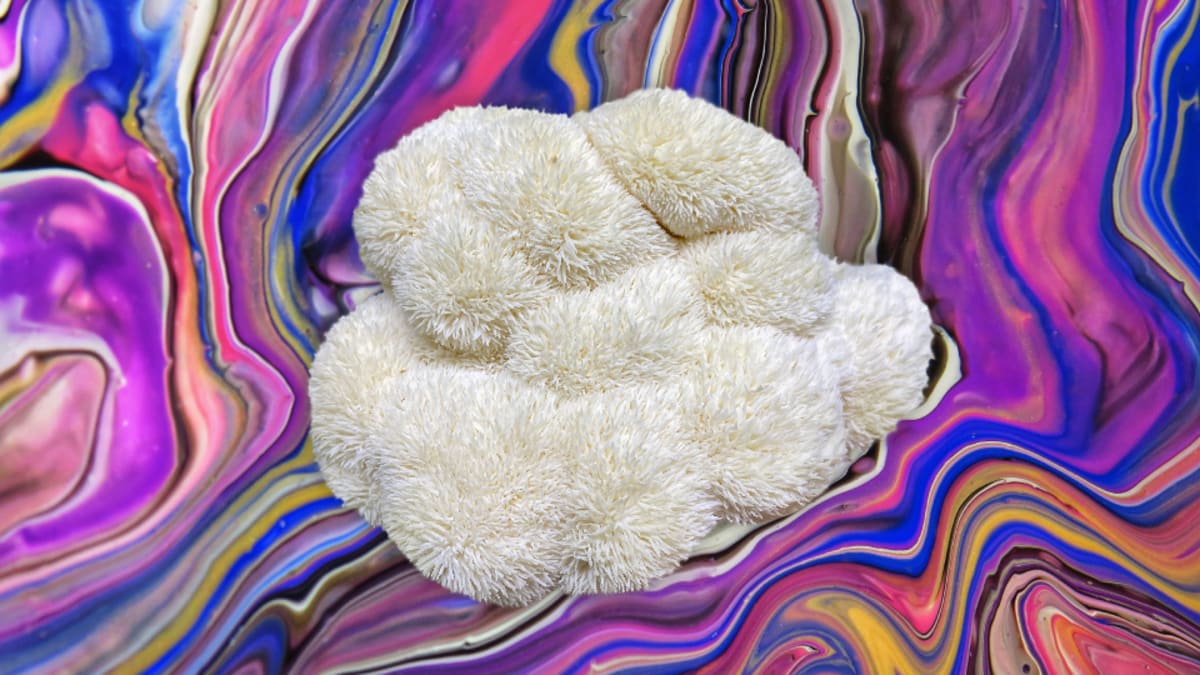
Lion's mane is not psychedelic. Full stop. It has no psilocybin, triggers no hallucinations, and leaves perception exactly where you left it. What it does instead is push the brain toward producing more nerve growth factor through two specific bioactive compounds called hericenones and erinacines. That process unfolds gradually over weeks, not in the first hour of a dose.
Key Takeaways
- 1Lion's mane contains no psilocybin or any other controlled psychoactive substance
- 2Its active compounds, hericenones and erinacines, stimulate nerve growth factor production supporting neuron health
- 3A 2025 double-blind trial found measurable cognitive and mood improvements from a single standardized dose in healthy adults
- 4In the Stamets stack protocol, lion's mane is added for neuroplasticity support, not psychedelic effect
- 5Lion's mane is legal in all 50 US states and most countries worldwide
Why people think it might be psychedelic
The confusion is understandable. Lion's mane keeps turning up in conversations about psilocybin, microdosing stacks, and consciousness research. If your first exposure to it was inside a discussion about psychedelics, assuming the connection runs deeper than it does is an easy mistake.
The name doesn't help. "Functional mushrooms" is a broad label that sweeps reishi, cordyceps, and lion's mane into the same bin. Psilocybin mushrooms sometimes get called "functional" in casual use too, even though they're an entirely separate category. The vocabulary gets muddled fast.
Then there's the Stamets stack. Paul Stamets, a well-known mycologist, popularized a protocol that pairs psilocybin with lion's mane and niacin. That created a genuine link in a lot of people's minds between lion's mane and psychedelic experiences, even though lion's mane plays a completely different role in that combination.
The actual dividing line is chemistry. Psilocybin mushrooms produce psilocybin and psilocin. Both are Schedule I controlled substances in the US, and both bind serotonin receptors in ways that distort perception. Lion's mane produces hericenones and erinacines, which work on an entirely different biological pathway and trigger nothing hallucinogenic.
What hericenones and erinacines actually do
These two compound classes come from different parts of the fungus. Hericenones are in the fruiting body, the white shaggy growth you'd eat or extract. Erinacines come from the mycelium underneath. Both push nerve growth factor biosynthesis upward, but through distinct molecular routes.
Nerve growth factor is a protein the brain relies on to keep neurons healthy and build new connections. The TrkA and ERK1/2 signaling pathways carry that signal. A 2023 review in the Journal of Fungi mapped this mechanism across multiple study models, confirming that both erinacines and hericenones promote neurite outgrowth and protect existing neurons.
The effect is not immediate. You won't notice anything in the first hour. Changes accumulate over weeks as neurons get sustained support. We tracked this over a 60-day period with a fruiting-body extract. Mental clarity crept up slowly, most visible in sustained attention during long afternoon work blocks. Nothing sudden. Nothing perceptual. Just less friction overall.
Mood is a bit different. A 2025 double-blind, randomized controlled trial in healthy younger adults found measurable cognitive and mood improvements within hours of a single standardized dose. That's faster than you'd expect from a neuroprotective compound, and the mechanism behind that speed isn't fully mapped yet. But a subtle shift in subjective mood is nowhere near altered perception of reality. Those are not the same outcome.
The Stamets stack and what lion's mane actually contributes
The Stamets protocol combines sub-perceptual psilocybin doses with lion's mane extract and niacin. Stamets proposed it based on the idea that lion's mane might bolster neuroplasticity while the psilocybin works, and that niacin could help shuttle compounds into the peripheral nervous system.
Based on what the biochemistry tells us, lion's mane has no psychedelic-adjacent mechanism. Its presence in the stack is about long-term neuronal support rather than amplifying any acute effect. Supporting neuron health during a stretch of heightened neuroplasticity is a reasonable idea, but lion's mane does not "boost" a psilocybin experience. The compounds simply don't work that way.
If you want cognitive support on its own, lion's mane stands fine without psilocybin in the picture. If microdosing is the goal, lion's mane is there for its own separate reasons, not because it makes anything more psychoactive.
What lion's mane does to cognition over time
Without psilocybin anywhere nearby, lion's mane produces effects that build gradually rather than arriving all at once.
Animal studies show that erinacine A supplementation improves cognitive function and memory formation. Erinacine A is one of the more well-studied compounds in this class and tends to show up at higher concentrations in mycelium-based extracts.
Fruiting-body extracts run heavier on hericenone content. Both forms have clinical backing, but they target slightly different aspects of nerve growth factor stimulation. Over eight weeks with a fruiting-body powder, we saw the clearest gains in working memory tasks and in reduced mental fatigue during cognitively demanding stretches of work. No perceptual changes. No mood swings. Nothing you'd call altered consciousness, even loosely.
Lion's mane is a slow-build supplement. It operates through biochemical pathways, not receptor binding, which is the whole mechanism behind classical psychedelics. If perceptual effects are what you're after, this mushroom isn't the one.

Legal status and safety
Lion's mane is legal across all 50 US states. It is not a controlled substance in the United States, the UK, Canada, or the European Union, and you can buy it openly as a supplement, a powder, or a food ingredient without any legal concern.
Psilocybin mushrooms are another story. They remain Schedule I under federal US law, though some cities and states have moved to decriminalize or legalize them in limited contexts. If you're sorting out which mushroom is which, the practical test is simple. Any mushroom sold openly as a dietary supplement is not a psychedelic.
On the safety side, clinical studies show no liver toxicity signals from lion's mane use. Gastrointestinal complaints show up in fewer than 10% of subjects. People with a known mushroom allergy should approach it carefully and talk to a doctor first. For most users the safety profile is well-documented.
Lion's mane has no addictive potential. For more on that specific question, see our piece on whether lion's mane is habit-forming.
Once you know lion's mane is the right fit for your goals, the next practical question is timing. We cover dosage windows and daily protocols in our guide to when to take lion's mane.
Frequently Asked Questions

A dedicated wellness researcher who spent decades cataloging the impact of forest-based nutrition on human aging. Ashley doesn't care about trends; she cares about the data.
References & Further Reading
- Hericium erinaceus in Neurodegenerative Diseases: From Bench to Bedside and Beyond, How Far from the Shoreline? — Journal of Fungi (2023)
- Acute effects of a standardised extract of Hericium erinaceus (Lion's Mane mushroom) on cognition and mood in healthy younger adults: a double-blind randomised placebo-controlled study. Front Nutr 2025 — Front Nutr (2025)
- Dietary Supplementation of Hericium erinaceus Increases Mossy Fiber-CA3 Hippocampal Neurotransmission and Recognition Memory in Wild-Type Mice. Evid Based Complement Alternat Med 2017 — Evid Based Complement Alternat Med (2017)