 Mushroom Health Hub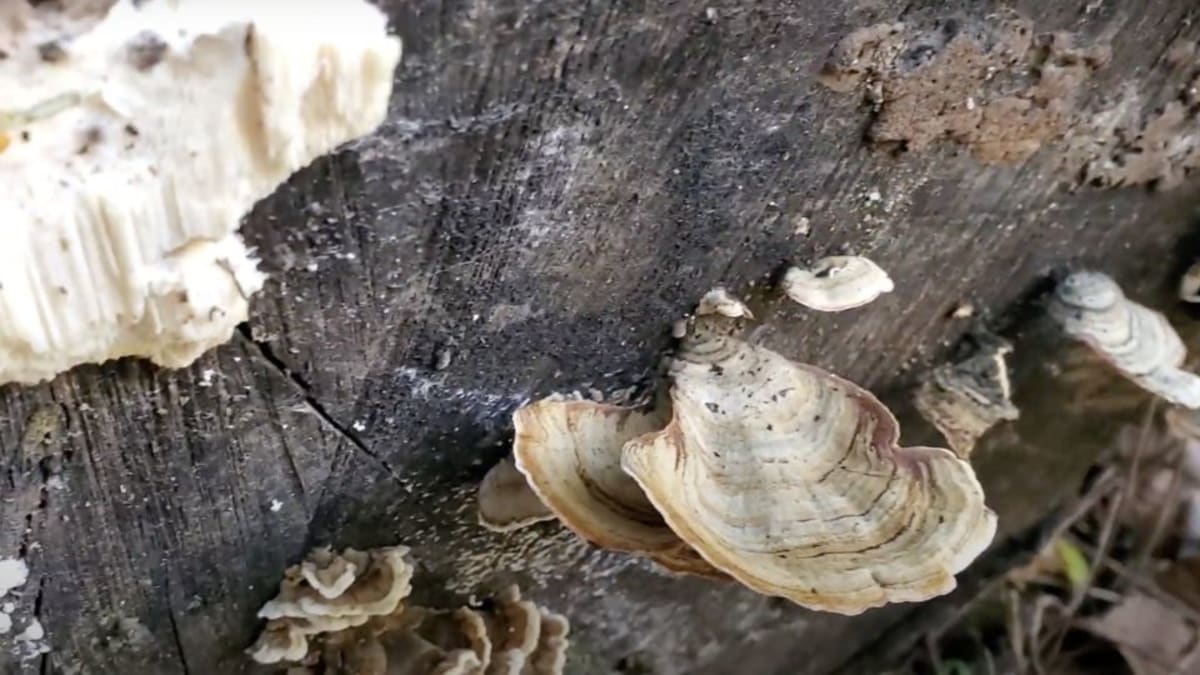
The false turkey tail is a crust fungus formally known as Stereum ostrea. It fruits in overlapping clusters on dead hardwood. Foragers confuse it with the true turkey tail mushroom all the time because of that banded cap. Look at the underside. Check for pores. While the authentic medicinal version contains heavily researched immune-modulating polysaccharides that dominate clinical literature, the false turkey tail remains an inedible species that modern researchers currently study for industrial and antibacterial applications. Over multiple seasons we have tracked both species in the same forest patches to lock in the exact visual markers that separate them in the field.
Key Takeaways
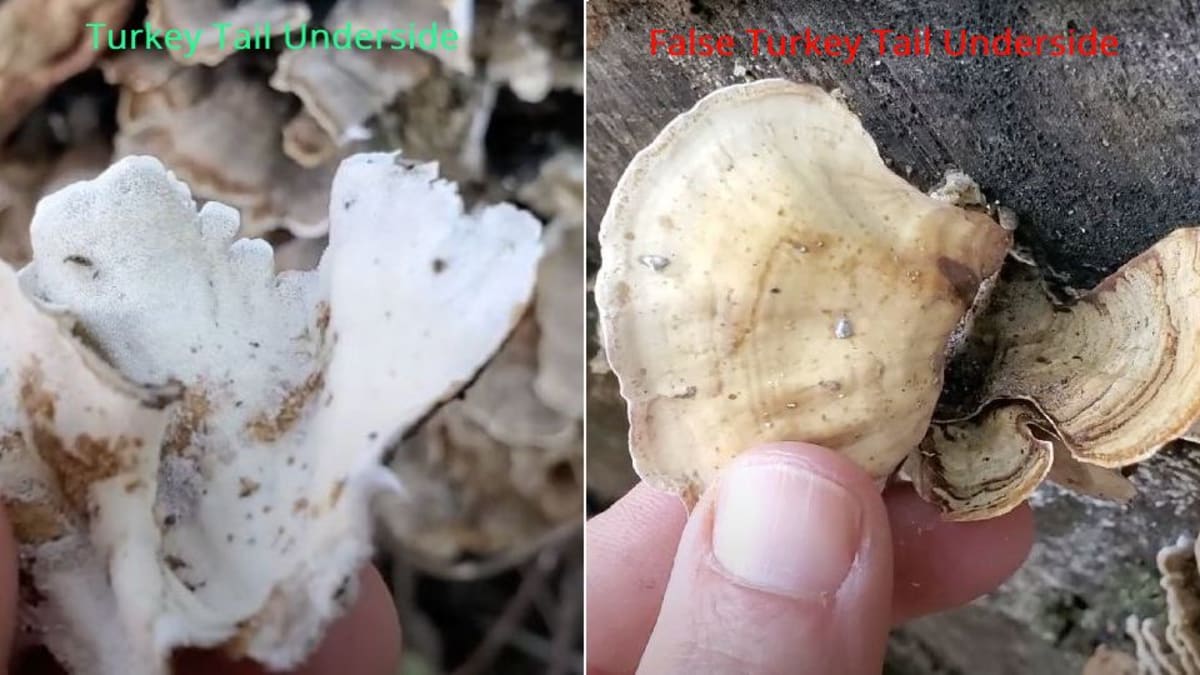
- 1True turkey tail has 2-4 pores per millimeter on a white underside - false turkey tail has no pores at all, just a smooth pale tan hymenium
- 2Stereum ostrea belongs to Russulales while Trametes versicolor sits in Polyporales - this evolutionary distance eliminates the high-molecular-weight beta-glucans entirely from the false variety
- 3A 2025 MDPI study found Stereum ostrea extracts inhibit Staphylococcus aureus at 10mg/mL MIC - but these sterostreins and terpenoids differ completely from the immune-modulating PSK and PSP in true turkey tail
- 4Spore prints confirm ambiguous field IDs - genuine Trametes versicolor leaves a stark white deposit while Stereum ostrea drops a pale cream print
The Biology and Chemistry of a Crust Fungus
Top-down appearances deceive amateur foragers. Stereum ostrea and Trametes versicolor mirror each other from above. But true turkey tail sits within the Polyporales order while the false variety belongs to the Russulales family. This evolutionary distance creates massive differences in physical structure and chemical makeup.
Flip the fruiting body over to spot the mechanical differences. True turkey tail pushes spores through microscopic tubes. We count two to four pores per millimeter on a mature specimen, and a standard jeweler's loupe quickly reveals this tightly packed network of reproductive plumbing covering the entire lower surface. False turkey tail completely lacks these tubes. It produces a flat parchment-like hymenium where basidia release spores directly into open air. This underside usually takes on a pale tan or yellowish tint. The authentic medicinal mushroom stays stark white or cream.
We rely on spore prints to confirm field IDs. Lay a mature cap flat on a glass slide. Wait overnight. In our testing we ran prints on 30 specimens collected across oak and maple logs over two autumn foraging seasons. The true species drops a stark white print every time. Stereum ostrea leaves a pale cream deposit. Decades of clinical trials focus on polysaccharide-K and polysaccharopeptide in true turkey tail, but Stereum ostrea lacks these high-molecular-weight beta-glucans, choosing to synthesize a completely different set of alternative terpenoids instead. Laboratory analysis identifies compounds like sterostreins and methoxylaricinolic acid buried inside its dense cellular matrix.
These leathery fruiting bodies hold industrial promise. But they do not belong in a morning wellness routine. Stereum ostrea is a white-rot fungus that secretes peroxidase enzymes to break down lignin in dead oak trees. This decomposition leaves behind stringy white cellulose. The fungus absorbs the resulting nutrients to build its solid fruiting bodies, and the concentric color bands on the upper cap reflect seasonal growth spurts driven by local rainfall fluctuations. The final biological structure remains far too unyielding for the human digestive tract to process.
Four Common Morphological Variations and Lookalikes
Nature throws out several fan-shaped fungi that mimic this banded aesthetic. We currently track four common imposters scattered across North American and European forests. Each has a unique morphological tell.
Stereum ostrea acts as the primary point of confusion. It forms wide individual funnel shapes that curve upward at the margins. Algae routinely colonizes its older caps. This creates a green wash across the brown and rust-colored concentric zones while the leathery fruiting bodies reach up to seven centimeters across. They grow as individual brackets and rarely fuse into massive overlapping shelves. You will spot them year-round on decaying deciduous wood.
Stereum hirsutum is a smaller and hairier sibling. Look closely at the surface and feel the bristled texture. We identify it by its bright orange and yellow banding combined with a highly textured upper cap, though the entire fruiting body rarely exceeds three centimeters in diameter. This crust fungus shares the smooth poreless underside of its larger relative. The bright coloration fades quickly into a dull gray under direct sunlight.
The Violet Toothed Polypore presents a different identification challenge. Trichaptum biforme grows on the same decaying oak logs and displays similar concentric growth rings. Our field foragers always look directly at the hymenium to spot the deception. The underside displays jagged tooth-like projections. The margins often display a purple hue when fresh. This color dulls to a muddy brown as the mushroom drops its mature spores during late autumn.
The Gilled Polypore shares a genus with the true turkey tail and possesses the same tough texture. We identify this imposter by checking the reproductive surface for rigid gills. Trametes betulina uses these blade-like structures to maximize spore dispersal area. The white and cream-colored cap lacks the high-contrast color banding seen in the other species. We routinely find it growing on birch and oak stumps.
Current Industrial and Scientific Applications
Woodland foragers ignore Stereum ostrea. Its tough texture ruins any culinary potential and our extraction protocol strictly excludes it from all medicinal supplement formulations. But modern research labs study this wood-decaying fungus as a potential source for novel antimicrobial agents.
Researchers pull compounds using solvents like methanol and ethyl acetate. A 2025 MDPI study on corticioid fungi demonstrated that Stereum ostrea extracts inhibit the growth of Staphylococcus aureus in laboratory settings, with the mycologists establishing a minimum inhibitory concentration of ten milligrams per milliliter against Bacillus subtilis. The liquid culture filtrate suppressed Gram-positive bacteria. The fungus produces sterostreins that show measurable antimalarial properties in isolated cell testing. These molecules disrupt bacterial biofilms and defend the fungus against competing micro-organisms fighting for space on decaying logs.
Industrial chemists also utilize the mushroom for green synthesis. The high phenolic content in the fungal biomass acts as a natural reducing agent, so scientists use these extracts to convert metal ions into microscopic particles without generating toxic chemical byproducts. A 2025 materials science study extracted phenolic compounds from Stereum ostrea biomass and synthesized copper nanocomposites for antibiofilm coatings. Fungal derivatives like these bypass the need for harsh chemicals in commercial manufacturing.
Traditional rural communities in Southeast Asia occasionally boiled the leathery brackets into rough decoctions for localized inflammation, but we advise against this practice. The fungus often absorbs heavy metals from contaminated wood. It triggers nausea or stomach cramping in many individuals, keeping it entirely off our supplement roster. For sourcing actual medicinal turkey tail, see our guide on where to buy turkey tail mushroom.
Frequently Asked Questions
Gordon is a former high-tech researcher who traded his silicon chips for spores. With a background in molecular visualization, he spends his time mapping the intricate structures of medicinal fungi.
References & Further Reading
- International Journal of Food Science 2025 — International Journal of Food Science (2025)
- MDPI 2025 — MDPI (2025)